Saturday, 11 March 2017

The pig's placenta: in sickness and in health

That’s disgusting!  Uhhh, don't do that!” his voice was echoing in the farm office.  Seventeen-year old Ethan screamed when he heard me telling his dad that I had to get into their piggery to gather some fresh pig placentas.   

“Really?!  What are you gonna do with it?” he asked. 

“I will have to ‘milk’ it so I could collect the placental umbilical cord blood in a tube and submit it to the diagnostic laboratory,” I answered with a modulated voice hoping that this young farmer with Asperger Syndrome could understand what I meant.


IT WAS A BRIGHT AND COOL early autumn morning at the Victoria-New South Wales border, I entered the farrowing (act of giving birth in pigs) room all geared up for the scheduled sample collection that Thursday.  There was an increasing number of sows (mother pigs) in this piggery farm that could hardly get pregnant, the number of piglets born alive had been getting lower with higher rate of piglets born dead or mummified (we call it lan-os in our dialect).   

Matthew—the farm owner, who’s running the farm himself looked very frustrated at the office earlier while he was telling me about his farm’s current reproductive performance.  Their farm facility was relatively modern, obviously well-updated to keep up with the demands of the pig farming industry.  Matt added that aside from breeding issues, there had been an increasing number of dead pigs in the weaner and grower sheds despite their regular improvements in husbandry, health and nutrition. 

Their consulting veterinarian asked for a favour; he requested if our company could extend some diagnostic services so, together, we could discover the real health issue of this piggery and eventually come up with a practical and cost-effective solution for them.  Having been working with this pharmaceutical company that’s not just selling the product but offering some 'value' beyond the bottle was the main reason why I was, at that moment, checking the farrowing crates of the piggery to see if there were fresh afterbirths lying behind the newly-farrowed sows. 

The placenta of a pig (diffused).
Source: http://merrilysanimalsciencejournal.blogspot.com.au

EVERY PIGLET BORN has its own placenta, and because the average piglets born per sow at Matt’s Piggery were 9, I could expect 9 placentas from each sow.  Disgusting as it may seem, the gelatinous placenta was actually the ultimate reason why a piglet is born at full term— alive and healthy at the average of 114 days.  Sadly, the placenta that gives life could potentially get infected thus becoming an unwanted medium of disease transmission!
Human placenta, disc-shaped (DISCoidal).
Source: 
Regeneration Center of Thailand

Placental development in pigs starts 17 days after fertilization, and unlike the human baby’s placenta that attaches to the womb like a disc (discoidal), almost the entire surface (diffused) of the baby piglet’s placenta is attached to uterine wall of its mommy!  And again, unlike in humans, the pig placental attachment is just a superficial connection of the lining of the foetal membrane that doesn’t create a deeper invasion into the inner wall of the sow’s womb (epitheliochorial). 
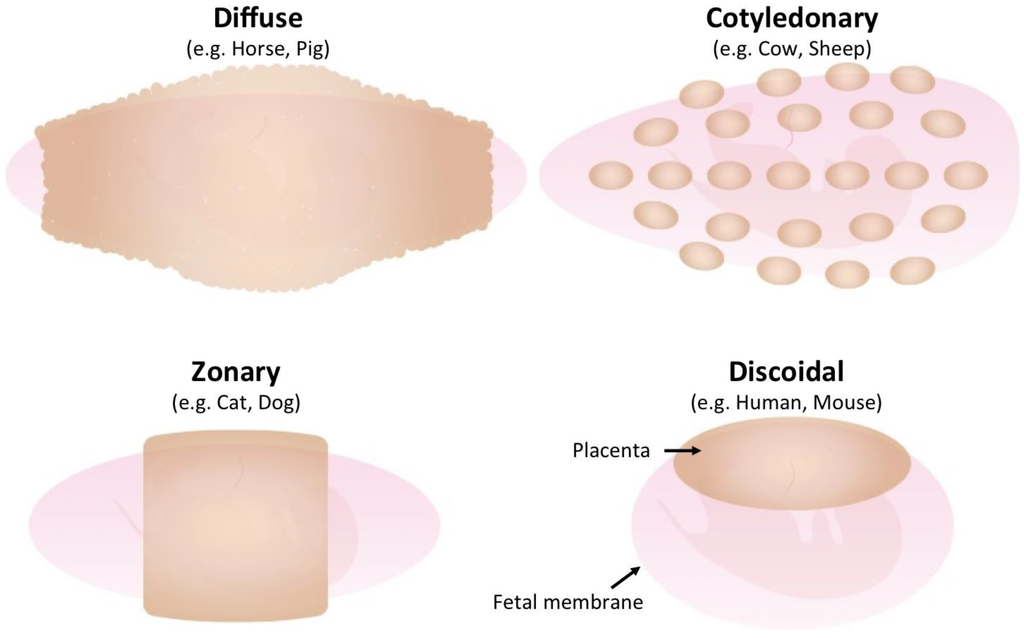
Placentation in animals, the shaded brownish area shows the attachment of the foetal membrane to the uterine wall.
Source: vle.du.ac.in  

Swine placenta is extra-gelatinous compared to other animal species— it is a sac containing fluids and blood vessels extending around the piglet to protect and nourish it.  These tiny ducts and vessels gradually converge together to become a bigger, highly functional sow-to-foetal piglet 'link' known as the umbilical cord that's approximately 12 centimetres (4.7 inches) in length!  Since the lungs and intestines of a developing piglet are not functional, the placenta, through meticulous blood filtration, supplies oxygen and nutrients from the sow to the piglet via the umbilical cord.

Classification of placentas based on histological assessment of the maternal-chorion interface.
Source: http://www.nature.com/ni/journal


MY HEART LEAPT when, finally, I spotted a sow lying and continuously grunting as if calling for her eight groggy, pinkish and damp ‘babies’ scattered around the heated and well-lit farrowing crate.  While I was having fun observing these cute little piglets as they obviously blinked, innocently root around and tried to find their way up to their mum’s udder, I noticed some streaks of fresh, maroon mucous staining the sow’s ham, tail and hock.  There was also a pile of placenta behind her.  That’s what I exactly need, I almost screamed at myself!     

I asked for assistance from the lovely farrowing room attendant.  Luckily she was happy to hold the red-topped blood tube for me as I individually picked-up the slimy, expelled-inside-out afterbirths— I would manually tear each one of them to expose and grab the umbilical cord stump...  We were both double-gloved and wearing facial mask and goggles to protect ourselves from the potentially contaminated splatters but I could sense her revulsion to what I was doing especially when I uncovered two mummified pig foetuses hidden under the pile of afterbirths!  

I skillfully held each placenta, cut the clotted end of the navel cord off with a pair of scissors and desperately squeezed the blood out from the placental vessels through to the severed end of the cord that was comfortably resting inside our sampling tube.  The process had to be repeated until I could come up with one substantial diagnostic sample— a collection of placental umbilical cord blood from 3-4 placentas sourced from one donor sow. 

A simple illustration of Placental Umbilical Cord Blood sampling.  
Illustrated by: Ruel P. Pagoto, DVM


THE PLACENTAL UMBILICAL CORD SERUM (PUCS) samples from a farm are the best diagnostic tools to establish the occurrence of in-utero transmission of Porcine Circovirus 2 (PCV2).  In addition to what has been commonly observed in weaner and early grower pigs (emaciated, hairy, yellowish pigs with varying sizes of red patches on their skin) around the globe, the infective level of PCV2 in gilts (a young female swine), sows and boars could directly affect their reproductive performance.  This was the reason why we decided to collect PUCS from Matthew’s Piggery; I submitted the precious samples we collected to the diagnostic lab so they could check for the presence of viral DNA for us. 

Don’t worry; PCV2 virus doesn’t cause disease in humans so we’re safe.  

In pigs, it can be transmitted via direct contact (nose-to-nose, mouth-to-nose), by contaminated needles, and through the boar’s semen!  Unlike influenza virus, PCV2 virus is sort of ‘naked’ or non-enveloped, and its DNA contained in a naked capsid is single-stranded; but as it gets into the sow’s womb during breeding (via semen), this virus would acquire some necessary proteins from its host transforming itself into a double-stranded DNA virus— which makes it highly replicative!  PCV2 will then divide and invade the sow’s blood stream (viraemia) thus having the potential of infecting the developing embryo at all stages of the reproductive cycle!
The Porcine Circovirus2 before and after infecting a pig.
Illustrated by: Ruel P. Pagoto, DVM 


If the embryo gets infected on the early stage of development, embryonic resorption could occur.  When PCV2 infection happens after foetal bone development has commenced (35 days after fertilisation), it could result into a mummified piglet!  Luckily, the piglet’s immune system (thymus) would start to develop but NOT fully functional at 70 days of gestation (pregnancy), so when the foetal pig gets infected on or beyond this period— the immune system would try to combat the infection, it may survive, otherwise, a weak, sick or dead piglet is born.
PCV2-related reproductive failure.
Source:  Boehringer Ingelheim CircoFLEX brochure.


Interestingly, as with other diseases’ dynamics and severity, not all sows get infected with PCV2 at the same time.  Sows that get infected would develop protective antibodies against the virus that are passed on to the newborn piglets via colostrum; piglets of these infected sows are therefore protected but could potentially shed the virus to the piglets born out of an uninfected sows that, of course, haven’t developed specific protection!  This could be the reason why increasing number of weaners and young growers at Matt’s Piggery would still get sick and die despite the updated health and nutrition program they’ve been implementing in the farm.                          
PCV2 infection and immunity.  
Illustrated by Ruel P. Pagoto, DVM

The lab test result was released 4 days after we submitted the samples.  It's positive, trans-placental transmission was happening at the piggery farm!  

We went back to the farm to give our recommended health program and Ethan was attentively listening to what we had to say during our meeting with his dad.  It was clear to him that we were there to look after the health of their pigs.  A ‘blanket’ PCV2 vaccination in boars and sows (regularly boosted twice a year) was implemented.  All the incoming ‘maiden’ gilts had to be vaccinated 2 weeks before their entry to the breeding herd and the piglets, as it had been successfully implemented— PCV2 vaccination at 14 days or older.


WHEN WE TESTED the same herd eight months later, there were no DNA copies detected from the PUCS samples submitted.  The farm’s performance had improved and the same health program was implemented to their other two pig breeding sites. 


.      
-----------------------------------------------------
References:
http://www.nda.agric.za/docs/Infopaks/Careofsowpiglets.pdf 
http://www.thepigsite.com/pighealth/article/220/parturition-farrowing/ 
http://placentation.ucsd.edu/pig.html 
Pig Diseases 9th edition by DJ Taylor
Swine Diseases 10th edition edited by Zimmermann et al.
Various publications by Boehringer Ingelheim

Thursday, 5 January 2017

My Time Capsule

My holiday has come to an end; this is my 7th since I moved to Australia last January 2007. 

Ten years have gone by... or if I add up all those years I spent away from the place I once officially called 'home', it's actually been 15 long years of physical absence! 


That 'home' is now my holiday destination and finding it could, sometimes, potentially get hard. The vegetation has significantly gotten lush and thick along the highway thus making the appearance of the landscape quite different from the time I last saw it. So despite my exhaustion after taking 4 plane rides  from Melbourne and finally a 3-hour PUV trip on the road, paying attention would be necessary so I could spot and get off at the right location.  

Every time I arrive at my 'holiday destination', there's that strange feeling of like coming out of a time capsule-- it's like I had been frozen for a while, thawed and awakened, then I feel like I am entering into an old place that's very familiar to me! 

Yes, welcome embraces were still warm and, actually, tighter but some things have obviously changed. Those kids have become grown-up teens, some faces have become wrinkled and those otherwise grey hairs are now regularly dyed. Ageing and vital-organ failure have gradually worn a pair of knees out; and if others are thriving with the aid of haemodialysis machines, there were those that have, sadly, given up and permanently departed. 

Geographically, our place still exists but a lot has changed! There are relationship bridges that have been, thankfully, constructed but there have been some freshly acquired wounds that resulted to a few unwanted walls being built. 
Several humble shelters were erected, and though renovations had been attempted-- ancestral houses have ended up dilapidated. 


I LEFT BIALONG YESTERDAY MORNING-- that little village where I didn't just simply grow-up but most of all-- the place where I learned most of the important lessons I need in life... and where the greatest memories of my childhood were made! 

My family and close relatives are aware that my nationality has changed but before I boarded the public utility van yesterday to commence my trip back to Australia, they sweetly asked me (with their tears held back, I knew), "So, when are you coming back home to visit us again?" I had managed to smile but opted not to answer the question. 

I have stepped back into my 'time capsule' once again (I am typing this aboard SQ 227) and I wish I could also lock my birthplace up in a time capsule so every time I come 'home' (as what my loved ones would prefer to call it), everybody and every family historic structure is still there-- alive, healthy and still standing tall! 

For the meantime, all I can do is lock them up tight and safe in my heart. 

.

Monday, 28 November 2016

Decaffeinated

It’s 11:22pm Melbourne time but I am still up and typing this post while having a cup of decaffeinated coffee (with, of course, some ‘biko’ that I cooked yesterday).  I had actually given up coffee for five days after suffering from intermittent vertigo attacks for almost a week.  Thankfully, caffeine abstinence is effective for me— I haven’t had that annoying dizziness for four days now!


But my cravings for this moreish drink never stopped; every morning or even after lunch, my desire for my favourite skinny flat white with ‘half’ sugar has just been getting more intense.  This must be part of the caffeine withdrawal symptoms, though I don’t have that characteristic headache that my late dad, who was an avid coffee drinker, was describing to me when he was experiencing coffee thirst.


WHILE WE WERE CHATTING on FB Messenger this evening, my friend Anna, who is also a coffee drinker, suggested that I might be able to get rid of this vertigo while at the same time enjoying coffee.  But there’s a catch— I have to drink decaffeinated coffee!  Oh boy, I haven’t thought about it, so at 10pm I found myself driving to Coles supermarket to get some coffee.

While at Coles, I noticed a few staff down the aisle who had just cleared an entire rack to give way to a display of a wide variety of Christmas decors!  I stopped to browse along the aisle hoping that I could get something for my unit.  There were different sizes and colours of reindeer, glistening metal balls, artificial pine needles made into wreath, mistletoes, Santa’s hat, socks, candy canes and the list goes on...  Sadly, I didn’t find what I was looking for—the nativity scene poster or figurines!  Not even an ornamental star! 

I just can’t believe that a supermarket giant has never considered or thought about selling (or even displaying) a nativity scene poster when in fact Christmas is all about celebrating the birth of Jesus Christ.  

As I drove home, what I had was only a pot of poinsettia to adorn my coffee table with, and a small jar of decaffeinated coffee in my shopping bag.  While navigating through the deserted, dimly lit streets of Bendigo, I was thinking that I may be able to manage vertigo attacks by drinking coffee without caffeine, but I definitely couldn’t celebrate Christmas without Christ, can I?      


.                       

Saturday, 5 November 2016

The Coughing Pig

So, what do you really do at work?”  This is the most common question my Facebook ‘friends’ ask me when I see them face-to-face.

Contrary to what they’d usually see on their FB newsfeed, I don’t just simply drive to the airport, hop on a plane and visit places for work.  There are actually more than a thousand things happening behind those photographs of beautiful destinations, delicious and great-looking dishes as well as drinks (well, I only order apple or orange juice most of the time).  

Actually, my FB friends just can’t believe that in between my FB and Instagram postings, I’ve also been seriously mastering the art of visiting a piggery, speaking with the farm owner, manager, staff or their consulting veterinarian, listening and counting the pig’s cough, checking the herd’s poo, collecting some blood samples, cutting dead pigs up, closely examining their internal organs and saving some thumb-size tissue samples if necessary—keeping these in small, transparent jars containing formalin solution and submitting these to the laboratory… Then when the test results come in, interpreting and coming up with a comprehensive case report.

Of all the activities I’d enumerate, listening to and counting the pig’s cough has been the most interesting and exciting thing for my friends, so far!  Some curious ones would innocently ask if I’d auscultate a pig’s chest using a stethoscope like what their GP would do to them while being asked to deeply inhale and exhale when they or their kids are examined for respiratory issues.  I’d politely reply that because my patients love to squeal when manually handled, and modern-day pig farming involves hundreds or thousands of pigs on one site, herd examination is more appropriate—thus attentively listening to the pigs’ cough—whether it’s dry or moist, long or short episode, and at the same time counting them are equally important.


IN THE PHILIPPINES, there’s this dish with Spanish origin called bopis which is made out of boiled pork lungs and heart—patiently cut into bits and pieces and sautéed in onion, tomatoes and chilies.  Unlike most of my friends, I, honestly, don’t like eating bopis and my repulsion from this Filipino-favourite pulutan (a dish that is slowly eaten while enjoying some bottles of beer or shots of spirits) started even before I became a veterinary student.  I just can’t handle chewing a spoonful of this smooth, soft and rubbery dish with those tiny, cartilaginous prickles from the pieces of offal tickling my tongue.

http://pulmonaryfibrosisresearch.org/nsip-2
Only when I enrolled in vet school and started studying veterinary anatomy did I learn that those rubbery portions that I felt when I chewed a spoonful of bopis were part of the functional tissues of the lungs that, when examined under the microscope, are actually tiny sacs made up or lined with flat and cuboidal cells.  These are called alveoli, which are perfectly known as air sacs because this is exactly where blood oxygen and carbon dioxide exchange occurs!

Oxygen, the life-supporting gas in animals, is actually taken in by the pig as it inhales air through its nostril.  The air will then pass through the left and right nasal passages—each of these contains lower and upper curled bones called turbinates.  Dr. Lumbao, my Veterinary Anatomy lecturer said they’re like turbines, while Muirhead and Alexander in their book Managing Pig Health described these turbinates as four hair curlers strategically placed inside the pig’s nose; these nasal ‘scrolls’ warm the inhaled air and at the same time creates air turbulence as the pig breathes.  As a result, larger particles (such as dust) are thrown out and attached to the mucous lining the airways.

https://www.pig333.com/pathology-atlas/rhinitis-and-turbinate-atrophy_94
Toxins produced by bacteria called Pasterurella multocida in synergy with the Bordetella bronchiseptica can lead to failure of the turbinate-bone growth and at the same time promoting its destruction—in the end the pigs’ snout will look distorted, affected pigs may be heard sneezing—a disease called atrophic rhinitis

The pigs’ airway, like other mammals, starts off as a series of 30 cartilaginous rings making up a windpipe or trachea.  This tube gradually branches down into three smaller tubes (bronchi)—actually unique for pigs because other domestic farm animals only have two.  These tubes continue to branch in right angles until it gets very tiny and microscopic pipes (bronchioles) that terminate into each of the air sacs.  These cartilaginous airways, I’ve learned, are the spikes that actually tickled my tongue the first and last time I had some bopis!

https://www.pig333.com/practical-experiences/evaluation-of-pneumonia-lesions-at-abattoir-with-lung-score-assessment_10946/

The airways are lined with mucous membrane where there are microscopic structures that resemble a pedantic display of 'goblets in a cupboard' thus aptly called ‘goblet cells’.  These cells produce mucous which, with the help of another microscopic feature of the airway—the hair-like projections (cilia) moving in a wavy manner, helps carry the nasty particles out from the lungs to the throat.  This is called 'mucociliary escalation'.

https://www.studyblue.com/notes/note/n/chapter-4-the-tissue-level-of-organization/deck/5452448


A PIG’S COUGH IS A DEFENSIVE REFLEX, considered protective as it aims to clear the lungs and the airways from irritants and foreign particles including harmful microbes that cause diseases.  Unfortunately however, coughing is also an excellent way of spreading pig respiratory diseases especially when the animals at risk and with varying status of immunity are sharing the same air space.    

photos from: www.carrsconsulting.com and http://www.merckvetmanual.com/

Viruses are too small; they can survive the mucociliary escalation and still reach and invade the pigs’ air sacs.  

Mycoplasma hyopneumoniae (Mhyo), a pig respiratory pathogen, loves to colonise and infect those tiny projections (cilia) lining the airways— so these will eventually stop moving, and start clumping together.  The first branch of the windpipe that's closest to the external environment the extra-bronchus that is unique in pigs supplies the right cranial lung lobe which is most commonly affected by this disease initially (photo above).
  
http://www.allwidewallpapers.com/swine-disease-prrs/
I knew what you're thinking, the pig’s immune system naturally secretes antibodies against Mhyo [Em-hayO] but these supposedly counteracting proteins can’t reach their ‘targets’ that are comfortably sitting on top of the clumped respiratory cilia.  So Mhyo will progressively multiply, white blood cells that serve as soldiers turn feeble and can’t keep up, and the mucosal lining will eventually peel off leaving the pigs’ airway devoid of goblet cells.  Loss of goblet cells simply means loss of mucous production resulting to a pig suffering from a dry, non-productive cough with very long episodes!      


SO WHENEVER OUR competent technical representatives and I are doing our job in the pig sheds or shelters, we’d wake the pigs up, continuously disturb them to stimulate them to cough.  With our tally counter and stop watches on, we’d then patiently listen to and count the coughing bouts within nine minutes.  Based on previous studies that checked the DNA of the microbes and the specific antibody level in a herd, a hundred pigs that cough twenty-four times or more in nine minutes would simply mean that a herd is unhealthy.

Sometimes it could get a bit complicated, as Mhyo is a primary invader—the damaged pig airways are now open to secondary respiratory pathogens!  Glasser’s disease, mostly occurring in weaners, is caused by a bug that damages the walls of the blood vessels in the lungs and other vital organs.  'Leaky' blood vessels result in a chest cavity containing fluids and appear like they're covered in feta cheese or spider web.  APP (Actinobacillus pleuropneumoniae) infection can also occur, mostly in grower or finisher pigs, and the toxins produced by this bug shatter the red blood cells, and create injury to the smooth covering (or pleura) that lines the chest cavity and the lungs.  The clinical signs could start as quick as 12 hrs after the disease agents have been inhaled by the pig... and with the characteristic feature of the condition where parts of the lungs are attached to the rib cage, this pleuropneumonia is obviously very painful— the pigs adopt a dog-sitting position while gasping for air and can only manage to cough once or twice per episode!  Microscopically, the air sacs will then be filled and densely packed with white blood cells; so to sum it all up these are basically the reasons why a pig's lungs are dark, firm and swollen, uncollapsed, attached to the rib cage, and most of the time the cut surface is oozing with blood upon examination!    

Yes, pig veterinarians, unlike companion animal and equine vets, or even unlike physicians, are highly privileged to be able to see the changes secondary to disease (or lesions) in their patients' internal organs by cutting up a representative pig—either dead or alive then euthanised—from a sick herd.  We can conveniently examine their 'plucks' while on the field or even in the abattoirs—just like what the vets and meat inspectors in the slaughter lines would routinely do as part of their post-mortem check to ensure that meat, including edible offal are fit for human consumption. 


BY VISITING THE herd, listening to their cough, looking at the lung lesions, and interpreting the lab test results, swine veterinarians can formulate solutions and give recommendations which, I believe, can provide assistance in promoting pig health and in producing more ‘pork’ for Australia and the world. 

…and when I say ‘pork’ it includes a healthy lung, as well.  That would mean more pork lungs for the bopis recipe of my friends, too!


.

Monday, 24 October 2016

Mi Corazón

It’s already mid-spring but this late winter nip seems to linger…

Breezy.  Chilly.  Gloomy.  My nights and days in the Goldfields have been always like this since you left.  Ever since you left me.

While desperately longing for your presence, all I could do is to wish; to wish that the sun will finally find its way out and start shining— not only to brighten my days but to, also, keep me warm!

Absurd as it may seem, your warmth as we snuggled up was a shelter of my heart.  A sanctuary that was destroyed by the ruthless storms of your goodbyes.

That heartbreak was drowning!  I almost believed that I lived no longer until I felt my heart beating…

Yes, it is still beating only for you.


.

Wednesday, 5 October 2016

Drenched


Things don’t always happen according to plans, he thought.

Just ten minutes earlier, the late afternoon, mid-springtime sun was boasting of its splendour and the blue sky beyond was visible through a huge hollow of low, thin, and fast-moving white-grey clouds hovering above Lake Weeroona.  The weather had been unfriendly for almost a week now—there were heavy rains and flooding but the condition a little earlier seemed to have gotten relatively better.  So James decided to run around this beautiful ornamental lake as if making a bold statement that he’s serious about his goal of shedding those pounds he’d gained over winter.

But after taking a few trots down the pathway, a strong gust of southeasterly wind started blowing; the cloud cover suddenly changed—it had gotten darker, instantly brought unexpected showers and freezing temperature around this man-made reserve.

James stopped running and stood on the boardwalk gazing across the lake while allowing himself to get drenched.  The people in the park—men and women, including the children on the playground nearby seemed to have vanished into nowhere as they quickly sought refuge from this unforeseen cloudburst!  All that’s left were flocks of Australian white ibis braving the rain and cold, perching on the sycamore sprigs and on the Japanese bamboo culm down the grove.

Now soaked, James closed his eyes and took a deep breath, unexpectedly inhaling the foul stench of ibis dung instead of fresh air!  Though that was much stronger, the smell reminded him of petrichor—that earthy scent emitted as the rain drops on a dry soil after a spell of drought.

Like this continent Down Under, James’ solitary existence had been through constant drought and flooding… It’s certainly uncertain; it hadn’t always gone according to plans.  His physique had gotten thoroughly wet now, almost frozen—pretty much like his spirit that’s been dampened by those unexpected storms in life.


.

Saturday, 20 August 2016

Coming 'home'

"So, where is home for you?"   

That is the question that I have, frequently, had to answer for almost a decade now. I admit I find it quite difficult to answer especially that I have lived under sixteen different roofs since I was fifteen years 'young'.  From a cramped to comfortable boarding houses when I was studying at the uni in the Philippines, to some small rental rooms and farm accommodations when I started to get employed in Luzon; and in Australia-- in some old country town residences, in a caravan, in a relatively modern room and a few apartment units.   

Having been granted with an Australian residency and eventually with an Australian citizenship didn't make answering the same question easy at all.  It has, honestly, made it a bit challenging to answer especially that (I have accepted this fact because I could never change it, I don’t mean to discriminate myself here that) my skin, eyes and hair colour is quite unique from the majority of the people living in this country where I work and live. Besides, I have this very strong accent and sadly, no matter how I tried, I still communicate using my broken spoken English.   

I have been living in Bendigo, Victoria, Australia for more than a year now.  This is a lovely regional city with elegant architecture and has been proud of it's history (Victorian gold rush, mid-1800's) to have been literally founded on precious gold!  It was recorded that the first dwellers of Bendigo moved to this place because of their desire to, obviously, find and accumulate treasure.   

For almost fourteen months of being a Bendigo resident, I have never been sure if this is where I actually live... still quite uncertain if this city is actually 'home' for me.  Yes, it feels great to be coming 'home' to my unit every weekend but I also feel 'at home' in those countless motels, hotels, serviced apartments and other accommodations where I would stay every time I'm off for a fieldwork on weekdays.  The drinks and the familiar musty and beery smell of the carpet at the small-town pubs, the meals at RSLs, those take-away lunches from the fast food while on the road and those refreshments onboard the aircrafts- all these make me feel ‘at home', too!   

I am yet to meet a few great friends in this community; it has never been easy to establish friendship especially that I have been always on-the-go. Don't get me wrong, though, because I love who and where I am now, and I definitely enjoy what I have been doing for a living.  Honestly, they're more than enough for me to confidently say that, somehow, I have found my treasure in this 'place'!   

So, where is home for me, then?   

For now, I'd say that that 'place' is this earth. The world is my oyster!  Yes, this is my 'home' because I live in this world.    


[Typed on my phone while on flight QF 679 Melbourne to Adelaide.  20.08.2016]

.