Sunday, 10 May 2020

masquerade

it’s bizarre how we'd sometimes feel to have lost something we had never actually owned,  i thought while i was carefully examining the colourful masks in a souvenir shop, feeling lost and suspended in the middle of the wandering crowd of tourists along a narrow Venetian alley.

* * *

it hurts!  and it was painful not because i was abandoned for someone else...  it's heart-breaking because for a few years, love seemed to have had me visually impaired only to realise, after all, that everything about my past relationship was a masquerade!

clearly, grieving was supposedly inessential; ridiculous as it might seem, i lamented over losing someone that wasn’t even mine.  that moment i wondered if me sobbing, in its real sense, was a sign of a weakness or a strength; then i'd find solace in the thought that it’s the coward, not me, who'd suffer more.   they’d say that enduring an interminable misery might, in the end, imperative should one choose to remain a coward— the one who’d bravely keep on hiding behind a stern face just to get applauded before the critical eyes of the society.

so mysterious these masks, when one's wearing one; how colourful and lovely to look at from the outside but it's horribly uncomfortable from the inside, i thought as i moved on to check out the next shop— determined to face and embrace the promise of a renewed life after this unknown period of my voluntary exile.

--------------------------- 
typed on a mobile phone, 02 November 2018; one sleepless night while in one of the rooms of Hotel Ca’ Del Campo, Venezia, Italia. 


Saturday, 25 April 2020

Blood-red...

The colour of the blood oozing from the bullet wounds of thousands of young soldiers, most of them in their late teens and early twenties, must have been similar to the colour of this rosebud I photographed at the park this morning.


I salute those boys and girls for their bravery in facing definite uncertainties as they sailed off to fulfil their first mission which, for most of them, sadly ended up as their final duty for their country.  I commend them for having the courage to leave not only their loved ones and their beautiful land, but also the promise of the bright future they could have had— had they opted to stay at home.


SO I ASKED myself.  Where was I when I was on my late teens and early twenties?  What was I doing?"  

I recalled I was studying to become a vet in a school not far from my hometown.  And yes, I had just completed that four consecutive years of the, then, compulsory military education and training for Filipino students...  yet I would not have been able to display the necessary gallantry had there been a call for me to be on the line of duty for national defence.  The coward in me could have just boldly or, better yet, easily convinced myself to rather stay and never ever dare to confront any bullet that could potentially shatter the dreams I had for my future.


BUT LOOK AT those young ANZAC heroes who, after getting off from the boat at dawn, selflessly weathered the torrential rain of bullets from the offending Ottoman armies, withstood the unutterable pain of wounds or burns, and down to the last drop, spilt their life-giving blood on the slopes— flooding the shores of that cove in Turkey more than a century ago.

For me, it is not just enough to only remember them.  We should be truly grateful for having this fair degree of peacefulness and freedom we currently enjoy in this world.  It may be admirable to emulate their heroism as we face any war in our modern era.  Aren't we luckier, somehow, to have received the command to stay and face this battle against the virus in the comfort of our own home?

Wednesday, 22 April 2020

The Barista in Me


These days, nightfall comes early and temperature (in 'C) would drop down to single digits overnight.  Having tired eyes from staring at computer screens the whole day, I put my vintage table lamps out soon after supper last night, just in time when Mr. Snoffles was coming in from his evening hunt.   I 'hit the hay' and as I was settling comfortably under the quilt, this tabby cat hopped on top of my bed and tunnelled his way under my blanket.


I FELT SATISFIED after a full night sleep.  I got up at six, gave Snoffles his morning 'bread', put my cool-weather gears on and walked down the sleepy streets to get some flat white from my newly discovered coffee bar.  I love their brew— the smoothness of the coffee flavour, the sweetness of the perfectly heated fresh milk in it... those natural tastes  that were gradually released as the barista meticulously worked on his machine.  So like a thirsty camel who has found its oasis, I've been coming here since Saturday to grab a drink!

Earlier, while I was across the counter watching the young barista preparing my order, I asked him about the secrets in making good coffee, "...is it the barista, the coffee beans or the machine?

"A bit of each," he casually replied and handed my take-away flat white to me.

As I walked down the sycamore-lined street, intermittently sipping some hot beverage from a holed cardboard cup clasped in my hand, I remembered my younger days back in the barrio when my late father would ask me to make a cup of instant coffee for him.  Yes, I was once a barista and I had a customer who genuinely loved coffee.  He'd tell me that I make delicious coffees; but, honestly, I would only follow his suggested techniques...  I'd only use briskly boiling water to re-hydrate a teaspoonful of freeze-dried coffee, then I'd add a rounded spoonful of powdered milk to it, stir and hand my brew to him.

I started drinking coffee and got addicted to caffeine only later in life, so, back then, I hadn't had the slightest idea how a great coffee should taste like.  Like the barista this morning, I didn't get to taste those doses of caffeine I handed to my only 'customer', I just trusted myself, believing that I made it right.  Consistency and love; I guess these were the important ingredients I added to my own brew back then.

Having spent his life in a secluded village— in a hut humbly standing in the middle of the ricefield, I wonder if my late dad, before at least facing his life’s untimely expiration, ever had the opportunity to taste and enjoy barista-made coffees during his regular visit the city to see his siblings... to enjoy this relatively sophisticated kind of brew that have become my favourite these days.  If he did have, then I’m sure, like the fluffy McDonald's pancake we, together, once had in Ilustre St., Davao, he would have been raving about this flat white.

Wednesday, 1 January 2020

Macaroni (a memoir)

I CLOSE MY EYES... and using my tongue, roll a heaping tablespoon of  short, curved, hallow pasta generously smothered in mayonnaise, hint of pickles, bits of pineapple, nata de coco, sultanas, tiny cubed cheddar and strands of boiled chicken breast in my mouth.  I completely ignore the starch and sugar contained in this dish as I start chewing it, alfresco, like having an amnesia— forgetting everything about that low-carb diet I’ve been following, after savouring this sort of a plat du jour from my own kitchen.


Sitting on this outdoor timber bench, I then sip some flat white, feel the, thankfully, cool January morning breeze as I watch my pet cat Snoffles sniffing and stalking around the garden on this quiet and bright new year’s day.   The potted succulent sitting on the matching timber table in front of me simply appear to be ignoring the cuts and scratches on its leaves as it raises its younger blades positively upward as if welcoming 2020 with much hope and delight!

I do look forward to the new year, praying for both mental and physical health as well as complete healing from the wounds of 2019, in short hoping for a happy and healthy days ahead but this macaroni-chicken salad I’m having for breakfast instantly take me back to how our family would celebrate the New Year in my childhood days.


HAVING SOME CHILLED MACARONI salad for breakfast would be a typical first day of the new year for me and my younger brother (I have a sister who’s seven years younger than me, could be the reason why she’s not present on this particular memory).  Unlike me who’s born in August— budget wise, the most challenging month for a rice farmer in Mlang, Cotabato, I’d think as a child that he was much luckier than I was.   He was born on a New Year’s Eve so he hadn’t had a birthday without a celebration, well, at least for me that was a ‘celebration’.  

I’d say that New Year’s Eve was more exciting for us than Christmas Eve, especially at dusk, set off by a faint audible sound of a motorcycle gradually becoming louder, heralding the arrival of our (now deceased) father from the town centre.  As children, my brother and I didn’t really care how and where would the resources come from, what was important for us was that our father had brought us a banquet for his birthday celebration!  There’s this roasted pig head along with its pleasant, distinct smoky aroma, the fluffy chiffon cake, the sliced white bread that would come with peanut butter contained in disposable cups covered with foil, and a box of sparklers which we would eagerly light at Media Noche.

Unlike most of the Filipino families, we seldom have a traditional collection of thirteen ‘round’ fruits at home.  If we’d have some, like calamansi or guava from our orchard, we’d arrange them in a tray and proudly place it on our modest, rickety dining table; sometimes, it’s not even a dozen.  Sadly incomplete!  Perhaps my mother was not a believer of such fortune these fruits would bring to the family who gathers these or most likely, we just couldn’t afford to buy that much variety of fruits on New Years Eve.  So what I could recall was a mom who couldn’t be bothered collecting colourful fruits but someone who’d try to put together the ‘cheapest’ ingredients so we could have our favourite macaroni salad as we welcome the new year.

I’d usually avoid using the word ‘cheap’, would prefer using ‘affordable’ instead, as the word cheap doesn’t only mean inexpensive but also inferior quality.  Something that is substandard.

But this time, ‘cheapest’ would be the most suited word to describe the ingredients our salad was made of as I could remember those curved, hollow, dried pasta packed in transparent plastic bags that didn’t cook and taste as great as Royal® Elbow Macaroni.  What our family could afford was something inferior than del Monte’s® macaroni, even cheaper than Fiesta® macaroni.  It was a macaroni without a brand, boiled and cooked as gracefully as we could under the canopy of banana leaves in our backyard using our big, old kaldero.

There were New Year’s Eve when we wouldn’t have enough cream and mayonnaise, obviously due to lack of finances even if my parents would choose not to purchase the first class Lady’s Choice®.  But as long as there were red and green kaong, some bits of pineapples, unbranded raisins, a small box of Eden® cheese—patiently cubed, and heaps of condensed milk, it was still called macaroni salad, wasn’t it?


BACK TO THIS FIRST MORNING of 2020, while enjoying my macaroni, alfresco, I start thinking.  Which is better: a not so great macaroni salad prepared and shared with my family or a perfectly creamy macaroni cooked al dente yet eaten quietly and alone on a new year’s day? 

Saturday, 27 January 2018

Fountain of Youth

photo credit:  Shutterstock
Obviously exhausted from his 12-hour flight from Melbourne, his hands were tucked into his cargo shorts’ pockets.  James Celdran was standing next to the foot-board of the hospital bed while blankly staring through the only window of room 208.  The cloud was low, heavy and dark; a few coconut trunks and palms were visibly swaying in the wind— silhouetting against the grey skies!  As seen from the second level of Mlang Specialist Medical Center, a heavy downpour was imminent… but he didn’t seem to care about Typhoon Vinta at the moment.
  
James’ 71-year old grandma was ill.  In the past few days, the world for him was an absolute grey monochrome!  The dullness outdoors was permeating through the window glass panel, softly illuminating this heart-breaking scene in the room.  As the nurse gently administered a drug via an IV line, the patient groaned.

It’ll be enough to alleviate the pain.  I’ll be back in 15 minutes to check her BP.”  The nurse left before James could even acknowledge.

He sat on the bedside bench, took hold of his granny’s wrinkled right hand and clasped it tightly in his.  It was pale and cold.  He squeezed it, looked straight into the eyes of his terminally ill grandmother and noticed those were welling up in tears.  James gently raised and placed his Lola Isobel’s frail knuckles on his forehead— as an absolute sign of Filipino respect and accepting a blessing from elderlies.

As the rhythmic beeping of the hospital machine continued to saturate the room, James got drowned in his emotions!  Then, gradually, those beeps interestingly turned into a ringing bell of an ice cream vendor peddling on the road thirty-five years ago…

That delicate hand he was currently clutching in the ICU was healthy, rosy, and warm back then.  It was the same hand that would hand him— a six-year old James— some coins so he could buy and enjoy his favourite ice cream flavour!  Those were the days when his granny’s creative hands would sew him countless pairs of comfortable pyjamas.  Those were the years when this strong and healthy hand would securely hold young James’ small hands while they were together doing their weekly marketing at the busy public market during Saturdays.


ONE SATURDAY MORNING IN April 1985, James and his granny were about to cross the street after getting off from a jeepney.  He, as a young boy, grabbed his grandma’s hand… but he wondered why her grip wasn’t tight enough?!

Then James suddenly realised that he’s back to the present time in that ICU— holding his ailing grandma’s delicate hand!

A…a… I’m se… se… scared…” the patient mumbled.  Then a plump grain of tear suddenly ruptured and ran down her cheeks.

James couldn’t deny that his granny didn’t want to die!  Not yet, he thought.  Not at seventy-one; his Lola Isobel was still too young to die, indeed!


OUTSIDE, A HEAVY DOWNPOUR COMMENCED... gradually turning the town’s streets into infinite shallow streams!  At that very moment, James and his family could only wish that these flood waters would eventually turn into a fountain.  Yes, a fountain of youth.


.

Sunday, 17 December 2017

Still waiting...


I TOSSED DOWN A GLASS of skinny latte and now staring across the wide window glass panel. I've been conveniently sitting on this bar stool, alone, amidst a crowd of cultured strangers that have been pacing back and forth while others are having a quick bite and taking their own dose of caffeine. There's a flat LCD screen on the wall-- inaudibly airing the news so I can't blame some of these outgoing passengers who opted to read the daily paper instead, while waiting for their boarding time.

This airline lounge has been bustling since I came in earlier this morning, and despite the orchestrating muffled sound of TV audio, the classic airport terminal voiceover and the continuous clanking of dishes, this themed room hasn't lost even an inch of elegance at all.


MY FLIGHT HAS BEEN DELAYED for two hours... and I was mocked by the irony of having a mobile phone that sent the alarm bells off to wake me up to get ready for my early morning flight but at the same time, the same device also informed me via SMS that my departure time has been moved.

Knackered from the five-day NZ 'workcation', I then decided to reset the alarm and buried myself in the softness of that meticulously-made bed with pillows dressed with smooth, bleached, immaculate linen! I dozed off for another hour.


NOW IN THIS LOUNGE, it seemed that a shot of caffeine from that latté had supplied enough stimulant to awaken my sleepy brain!

Instantly, under the gloomy Sydney sky, I now notice the aircrafts taking off, another three are taxiing on the damp tarmac, and there are passengers down there queuing to climb up the ladder to board a small plane...

What are they up to? Probably a business trip extended over the weekend... or maybe going home to spend the holidays with their family?

How about this passenger sitting next to me in this lounge? He's on his phone and I could smell something 'romantic' going on. Most likely, somebody is getting his favourite meal ready the moment he steps on the doorway... and that lovely young lady over there, a loved one must be have been waiting to give her a tight hug as she gets to her destination.

How about me? Well, not quite.

Today is just another day. Another typical day.

Monday, 3 April 2017

A Pig's Tale

IT’S 7:14pm AT OUR CURRENT LOCATION on-board QF5 en route to Singapore; the 'flight path' board says this Airbus 330 has already flown three quarters of the total time to our destination.  While the majority of the passengers have been dozing off in the comfort of their fully reclined ‘cradle’, my mobile phone screen illuminates my face as I type this 'note' amidst the darkened aircraft cabin.

As usual, I'm travelling for work.  There's not much difference as to what I'd normally do except for this being an international flight this time (there’s actually been a few of these since I joined the company 22 months ago).  I'll be away for the next six days to attend a meeting that will basically cover a few things about pigs as well as their health.  Who would've thought that working with these 'lesser beasts' (as what Mark Essig calls them in his book ‘A Snout to Tail History of the Humble Pig’) could also take me to places?  Trips like this would definitely bring a lasting and memorable learning experience!


ACTUALLY, MY VERY FIRST OVERSEAS trip was when I left my job as a pig veterinarian in the Philippines to embark on an extraordinary journey as a piggery attendant in Australia. That venture didn't last for more than a year, though...  Things may not have worked out as planned but I'd say that that was definitely the gate that opened the path of greater opportunities that lead me to where I am right now.

This ‘career’ actually started more than three decades ago, though at that time—as a six-year old boy, I'd call it an ‘adventure’.  I remember in the late 80's, Auntie Manay was into backyard pig raising— looking  after half a dozen grower pigs.  I would join her collect some stalks of gabi (taro) or tangkong (swamp cabbage) from the swampy areas of the family property, chop these 'veggies' and, using a firewood, cook these outdoor in a big pot with binlæd (a waste product of rice milling).  The cooked veggies were called la-on and when cooled down and mixed with upa (rice hull shavings from a grain while milling), this was the staple diet of our pig herd back then!  When these hogs would reach market size, Auntie Manay would sell them to the public-market butchers; it would feel a bit sad at the start seeing my 'pets' squealing while being weighed using a traditional weighing scale but after receiving the payment it would get more interesting as it was then the time to go to Davao City to shop and dine.  Meanwhile, after slaughtering, the butchers would usually give our pigs’ liver back to us as a consolation and that was absolutely a special dinner treat for the family!

Auntie Manay would usually own at least one Philippine native sow those days, would have it naturally bred by an outdoor-raised Duroc-Pietrain boar owned by Uncle Simo in the property nearby.  Every time the pregnant sow would get closer to its ‘due date’, Auntie Manay and I would sleep in the barn with the sow so we could assist during farrowing (act of giving birth in pigs).  That was actually quite exciting as the activity would include a guessing game as to whether the total piglets born alive would get up to a dozen or more!  Night duties would then follow over the next 7-10 days so we could look after the cute little piglets (most of them black, some were brown with black spots) at suckling time thus protecting them from the danger of being laid over and crushed by their dam.  I'd also witness the young male piglets' surgical castration performed by a trained technician who, at that time, would call himself a 'veterinarian'.


ONE TIME MY PARENTS got a female piglet as a gift from a family friend; completely clueless about gilt (maiden female pig) selection, Nanay and Tatay decided to have ‘her’ naturally bred.  I remember the poor sow only had six piglets born, and didn't even have the ideal teats (nipples) a mother pig should have!  Day-old piglet processing wasn't practiced at that time; we had no idea of proper sow management post-farrowing so the sow suffered from a hard and swollen udder which made her difficult to lactate!  The poor piglets, who also hadn't receive iron injection suffered from malnutrition, gradually became lethargic and died one after the other.  I shed buckets of tears out of grief. 
After finishing high school I wasn't, actually, the one who decided to enrol at vet school; my parents did... they groomed me to become a veterinarian.  It worked and ended up really well, though, because at the moment I definitely enjoy and love what I am doing.


THREE DECADES LATER, here I am, still working with pigs but definitely not in our small village in southern Philippines.  I have, somehow, started conquering the world because of swine production and medicine.  The great things about it: while looking after the welfare and health of the swine herd, I could help feed Australia and the rest of the world. 


-END-

Saturday, 11 March 2017

The pig's placenta: in sickness and in health

That’s disgusting!  Uhhh, don't do that!” his voice was echoing in the farm office.  Seventeen-year old Ethan screamed when he heard me telling his dad that I had to get into their piggery to gather some fresh pig placentas.   

“Really?!  What are you gonna do with it?” he asked. 

“I will have to ‘milk’ it so I could collect the placental umbilical cord blood in a tube and submit it to the diagnostic laboratory,” I answered with a modulated voice hoping that this young farmer with Asperger Syndrome could understand what I meant.


IT WAS A BRIGHT AND COOL early autumn morning at the Victoria-New South Wales border, I entered the farrowing (act of giving birth in pigs) room all geared up for the scheduled sample collection that Thursday.  There was an increasing number of sows (mother pigs) in this piggery farm that could hardly get pregnant, the number of piglets born alive had been getting lower with higher rate of piglets born dead or mummified (we call it lan-os in our dialect).   

Matthew—the farm owner, who’s running the farm himself looked very frustrated at the office earlier while he was telling me about his farm’s current reproductive performance.  Their farm facility was relatively modern, obviously well-updated to keep up with the demands of the pig farming industry.  Matt added that aside from breeding issues, there had been an increasing number of dead pigs in the weaner and grower sheds despite their regular improvements in husbandry, health and nutrition. 

Their consulting veterinarian asked for a favour; he requested if our company could extend some diagnostic services so, together, we could discover the real health issue of this piggery and eventually come up with a practical and cost-effective solution for them.  Having been working with this pharmaceutical company that’s not just selling the product but offering some 'value' beyond the bottle was the main reason why I was, at that moment, checking the farrowing crates of the piggery to see if there were fresh afterbirths lying behind the newly-farrowed sows. 

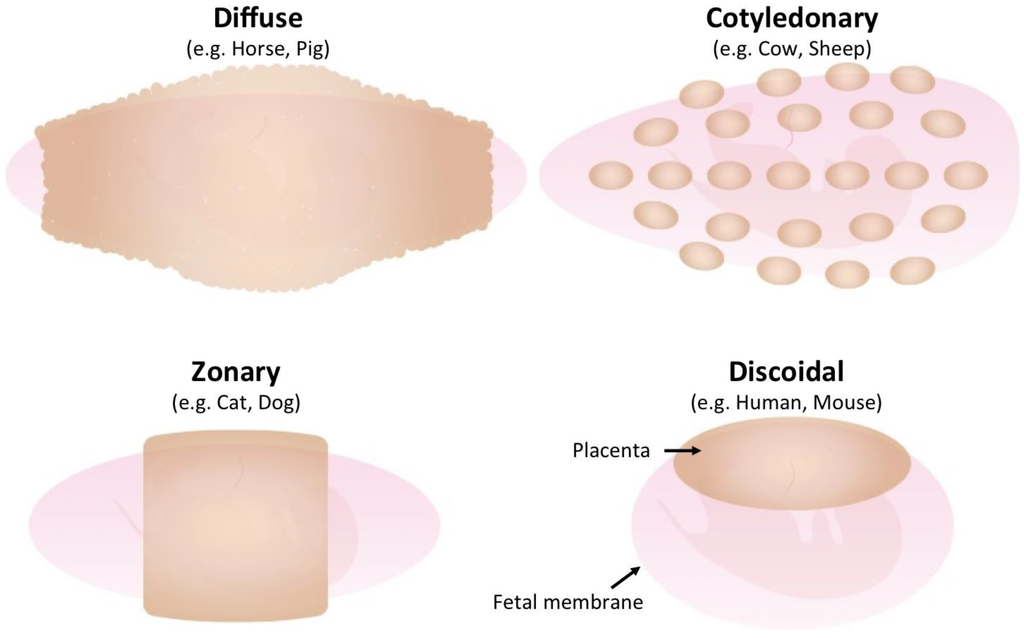
The placenta of a pig (diffused).
Source: http://merrilysanimalsciencejournal.blogspot.com.au

EVERY PIGLET BORN has its own placenta, and because the average piglets born per sow at Matt’s Piggery were 9, I could expect 9 placentas from each sow.  Disgusting as it may seem, the gelatinous placenta was actually the ultimate reason why a piglet is born at full term— alive and healthy at the average of 114 days.  Sadly, the placenta that gives life could potentially get infected thus becoming an unwanted medium of disease transmission!
Human placenta, disc-shaped (DISCoidal).
Source: 
Regeneration Center of Thailand

Placental development in pigs starts 17 days after fertilization, and unlike the human baby’s placenta that attaches to the womb like a disc (discoidal), almost the entire surface (diffused) of the baby piglet’s placenta is attached to uterine wall of its mommy!  And again, unlike in humans, the pig placental attachment is just a superficial connection of the lining of the foetal membrane that doesn’t create a deeper invasion into the inner wall of the sow’s womb (epitheliochorial). 

Placentation in animals, the shaded brownish area shows the attachment of the foetal membrane to the uterine wall.
Source: vle.du.ac.in  

Swine placenta is extra-gelatinous compared to other animal species— it is a sac containing fluids and blood vessels extending around the piglet to protect and nourish it.  These tiny ducts and vessels gradually converge together to become a bigger, highly functional sow-to-foetal piglet 'link' known as the umbilical cord that's approximately 12 centimetres (4.7 inches) in length!  Since the lungs and intestines of a developing piglet are not functional, the placenta, through meticulous blood filtration, supplies oxygen and nutrients from the sow to the piglet via the umbilical cord.

Classification of placentas based on histological assessment of the maternal-chorion interface.
Source: http://www.nature.com/ni/journal


MY HEART LEAPT when, finally, I spotted a sow lying and continuously grunting as if calling for her eight groggy, pinkish and damp ‘babies’ scattered around the heated and well-lit farrowing crate.  While I was having fun observing these cute little piglets as they obviously blinked, innocently root around and tried to find their way up to their mum’s udder, I noticed some streaks of fresh, maroon mucous staining the sow’s ham, tail and hock.  There was also a pile of placenta behind her.  That’s what I exactly need, I almost screamed at myself!     

I asked for assistance from the lovely farrowing room attendant.  Luckily she was happy to hold the red-topped blood tube for me as I individually picked-up the slimy, expelled-inside-out afterbirths— I would manually tear each one of them to expose and grab the umbilical cord stump...  We were both double-gloved and wearing facial mask and goggles to protect ourselves from the potentially contaminated splatters but I could sense her revulsion to what I was doing especially when I uncovered two mummified pig foetuses hidden under the pile of afterbirths!  

I skillfully held each placenta, cut the clotted end of the navel cord off with a pair of scissors and desperately squeezed the blood out from the placental vessels through to the severed end of the cord that was comfortably resting inside our sampling tube.  The process had to be repeated until I could come up with one substantial diagnostic sample— a collection of placental umbilical cord blood from 3-4 placentas sourced from one donor sow. 

A simple illustration of Placental Umbilical Cord Blood sampling.  
Illustrated by: Ruel P. Pagoto, DVM


THE PLACENTAL UMBILICAL CORD SERUM (PUCS) samples from a farm are the best diagnostic tools to establish the occurrence of in-utero transmission of Porcine Circovirus 2 (PCV2).  In addition to what has been commonly observed in weaner and early grower pigs (emaciated, hairy, yellowish pigs with varying sizes of red patches on their skin) around the globe, the infective level of PCV2 in gilts (a young female swine), sows and boars could directly affect their reproductive performance.  This was the reason why we decided to collect PUCS from Matthew’s Piggery; I submitted the precious samples we collected to the diagnostic lab so they could check for the presence of viral DNA for us. 

Don’t worry; PCV2 virus doesn’t cause disease in humans so we’re safe.  

In pigs, it can be transmitted via direct contact (nose-to-nose, mouth-to-nose), by contaminated needles, and through the boar’s semen!  Unlike influenza virus, PCV2 virus is sort of ‘naked’ or non-enveloped, and its DNA contained in a naked capsid is single-stranded; but as it gets into the sow’s womb during breeding (via semen), this virus would acquire some necessary proteins from its host transforming itself into a double-stranded DNA virus— which makes it highly replicative!  PCV2 will then divide and invade the sow’s blood stream (viraemia) thus having the potential of infecting the developing embryo at all stages of the reproductive cycle!
The Porcine Circovirus2 before and after infecting a pig.
Illustrated by: Ruel P. Pagoto, DVM 


If the embryo gets infected on the early stage of development, embryonic resorption could occur.  When PCV2 infection happens after foetal bone development has commenced (35 days after fertilisation), it could result into a mummified piglet!  Luckily, the piglet’s immune system (thymus) would start to develop but NOT fully functional at 70 days of gestation (pregnancy), so when the foetal pig gets infected on or beyond this period— the immune system would try to combat the infection, it may survive, otherwise, a weak, sick or dead piglet is born.
PCV2-related reproductive failure.
Source:  Boehringer Ingelheim CircoFLEX brochure.


Interestingly, as with other diseases’ dynamics and severity, not all sows get infected with PCV2 at the same time.  Sows that get infected would develop protective antibodies against the virus that are passed on to the newborn piglets via colostrum; piglets of these infected sows are therefore protected but could potentially shed the virus to the piglets born out of an uninfected sows that, of course, haven’t developed specific protection!  This could be the reason why increasing number of weaners and young growers at Matt’s Piggery would still get sick and die despite the updated health and nutrition program they’ve been implementing in the farm.                          
PCV2 infection and immunity.  
Illustrated by Ruel P. Pagoto, DVM

The lab test result was released 4 days after we submitted the samples.  It's positive, trans-placental transmission was happening at the piggery farm!  

We went back to the farm to give our recommended health program and Ethan was attentively listening to what we had to say during our meeting with his dad.  It was clear to him that we were there to look after the health of their pigs.  A ‘blanket’ PCV2 vaccination in boars and sows (regularly boosted twice a year) was implemented.  All the incoming ‘maiden’ gilts had to be vaccinated 2 weeks before their entry to the breeding herd and the piglets, as it had been successfully implemented— PCV2 vaccination at 14 days or older.


WHEN WE TESTED the same herd eight months later, there were no DNA copies detected from the PUCS samples submitted.  The farm’s performance had improved and the same health program was implemented to their other two pig breeding sites. 


.      
-----------------------------------------------------
References:
http://www.nda.agric.za/docs/Infopaks/Careofsowpiglets.pdf 
http://www.thepigsite.com/pighealth/article/220/parturition-farrowing/ 
http://placentation.ucsd.edu/pig.html 
Pig Diseases 9th edition by DJ Taylor
Swine Diseases 10th edition edited by Zimmermann et al.
Various publications by Boehringer Ingelheim

Thursday, 5 January 2017

My Time Capsule

My holiday has come to an end; this is my 7th since I moved to Australia last January 2007. 

Ten years have gone by... or if I add up all those years I spent away from the place I once officially called 'home', it's actually been 15 long years of physical absence! 


That 'home' is now my holiday destination and finding it could, sometimes, potentially get hard. The vegetation has significantly gotten lush and thick along the highway thus making the appearance of the landscape quite different from the time I last saw it. So despite my exhaustion after taking 4 plane rides  from Melbourne and finally a 3-hour PUV trip on the road, paying attention would be necessary so I could spot and get off at the right location.  

Every time I arrive at my 'holiday destination', there's that strange feeling of like coming out of a time capsule-- it's like I had been frozen for a while, thawed and awakened, then I feel like I am entering into an old place that's very familiar to me! 

Yes, welcome embraces were still warm and, actually, tighter but some things have obviously changed. Those kids have become grown-up teens, some faces have become wrinkled and those otherwise grey hairs are now regularly dyed. Ageing and vital-organ failure have gradually worn a pair of knees out; and if others are thriving with the aid of haemodialysis machines, there were those that have, sadly, given up and permanently departed. 

Geographically, our place still exists but a lot has changed! There are relationship bridges that have been, thankfully, constructed but there have been some freshly acquired wounds that resulted to a few unwanted walls being built. 
Several humble shelters were erected, and though renovations had been attempted-- ancestral houses have ended up dilapidated. 


I LEFT BIALONG YESTERDAY MORNING-- that little village where I didn't just simply grow-up but most of all-- the place where I learned most of the important lessons I need in life... and where the greatest memories of my childhood were made! 

My family and close relatives are aware that my nationality has changed but before I boarded the public utility van yesterday to commence my trip back to Australia, they sweetly asked me (with their tears held back, I knew), "So, when are you coming back home to visit us again?" I had managed to smile but opted not to answer the question. 

I have stepped back into my 'time capsule' once again (I am typing this aboard SQ 227) and I wish I could also lock my birthplace up in a time capsule so every time I come 'home' (as what my loved ones would prefer to call it), everybody and every family historic structure is still there-- alive, healthy and still standing tall! 

For the meantime, all I can do is lock them up tight and safe in my heart. 

.

Monday, 28 November 2016

Decaffeinated

It’s 11:22pm Melbourne time but I am still up and typing this post while having a cup of decaffeinated coffee (with, of course, some ‘biko’ that I cooked yesterday).  I had actually given up coffee for five days after suffering from intermittent vertigo attacks for almost a week.  Thankfully, caffeine abstinence is effective for me— I haven’t had that annoying dizziness for four days now!


But my cravings for this moreish drink never stopped; every morning or even after lunch, my desire for my favourite skinny flat white with ‘half’ sugar has just been getting more intense.  This must be part of the caffeine withdrawal symptoms, though I don’t have that characteristic headache that my late dad, who was an avid coffee drinker, was describing to me when he was experiencing coffee thirst.


WHILE WE WERE CHATTING on FB Messenger this evening, my friend Anna, who is also a coffee drinker, suggested that I might be able to get rid of this vertigo while at the same time enjoying coffee.  But there’s a catch— I have to drink decaffeinated coffee!  Oh boy, I haven’t thought about it, so at 10pm I found myself driving to Coles supermarket to get some coffee.

While at Coles, I noticed a few staff down the aisle who had just cleared an entire rack to give way to a display of a wide variety of Christmas decors!  I stopped to browse along the aisle hoping that I could get something for my unit.  There were different sizes and colours of reindeer, glistening metal balls, artificial pine needles made into wreath, mistletoes, Santa’s hat, socks, candy canes and the list goes on...  Sadly, I didn’t find what I was looking for—the nativity scene poster or figurines!  Not even an ornamental star! 

I just can’t believe that a supermarket giant has never considered or thought about selling (or even displaying) a nativity scene poster when in fact Christmas is all about celebrating the birth of Jesus Christ.  

As I drove home, what I had was only a pot of poinsettia to adorn my coffee table with, and a small jar of decaffeinated coffee in my shopping bag.  While navigating through the deserted, dimly lit streets of Bendigo, I was thinking that I may be able to manage vertigo attacks by drinking coffee without caffeine, but I definitely couldn’t celebrate Christmas without Christ, can I?      


.                       

Saturday, 5 November 2016

The Coughing Pig

So, what do you really do at work?”  This is the most common question my Facebook ‘friends’ ask me when I see them face-to-face.

Contrary to what they’d usually see on their FB newsfeed, I don’t just simply drive to the airport, hop on a plane and visit places for work.  There are actually more than a thousand things happening behind those photographs of beautiful destinations, delicious and great-looking dishes as well as drinks (well, I only order apple or orange juice most of the time).  

Actually, my FB friends just can’t believe that in between my FB and Instagram postings, I’ve also been seriously mastering the art of visiting a piggery, speaking with the farm owner, manager, staff or their consulting veterinarian, listening and counting the pig’s cough, checking the herd’s poo, collecting some blood samples, cutting dead pigs up, closely examining their internal organs and saving some thumb-size tissue samples if necessary—keeping these in small, transparent jars containing formalin solution and submitting these to the laboratory… Then when the test results come in, interpreting and coming up with a comprehensive case report.

Of all the activities I’d enumerate, listening to and counting the pig’s cough has been the most interesting and exciting thing for my friends, so far!  Some curious ones would innocently ask if I’d auscultate a pig’s chest using a stethoscope like what their GP would do to them while being asked to deeply inhale and exhale when they or their kids are examined for respiratory issues.  I’d politely reply that because my patients love to squeal when manually handled, and modern-day pig farming involves hundreds or thousands of pigs on one site, herd examination is more appropriate—thus attentively listening to the pigs’ cough—whether it’s dry or moist, long or short episode, and at the same time counting them are equally important.


IN THE PHILIPPINES, there’s this dish with Spanish origin called bopis which is made out of boiled pork lungs and heart—patiently cut into bits and pieces and sautéed in onion, tomatoes and chilies.  Unlike most of my friends, I, honestly, don’t like eating bopis and my repulsion from this Filipino-favourite pulutan (a dish that is slowly eaten while enjoying some bottles of beer or shots of spirits) started even before I became a veterinary student.  I just can’t handle chewing a spoonful of this smooth, soft and rubbery dish with those tiny, cartilaginous prickles from the pieces of offal tickling my tongue.

http://pulmonaryfibrosisresearch.org/nsip-2
Only when I enrolled in vet school and started studying veterinary anatomy did I learn that those rubbery portions that I felt when I chewed a spoonful of bopis were part of the functional tissues of the lungs that, when examined under the microscope, are actually tiny sacs made up or lined with flat and cuboidal cells.  These are called alveoli, which are perfectly known as air sacs because this is exactly where blood oxygen and carbon dioxide exchange occurs!

Oxygen, the life-supporting gas in animals, is actually taken in by the pig as it inhales air through its nostril.  The air will then pass through the left and right nasal passages—each of these contains lower and upper curled bones called turbinates.  Dr. Lumbao, my Veterinary Anatomy lecturer said they’re like turbines, while Muirhead and Alexander in their book Managing Pig Health described these turbinates as four hair curlers strategically placed inside the pig’s nose; these nasal ‘scrolls’ warm the inhaled air and at the same time creates air turbulence as the pig breathes.  As a result, larger particles (such as dust) are thrown out and attached to the mucous lining the airways.

https://www.pig333.com/pathology-atlas/rhinitis-and-turbinate-atrophy_94
Toxins produced by bacteria called Pasterurella multocida in synergy with the Bordetella bronchiseptica can lead to failure of the turbinate-bone growth and at the same time promoting its destruction—in the end the pigs’ snout will look distorted, affected pigs may be heard sneezing—a disease called atrophic rhinitis

The pigs’ airway, like other mammals, starts off as a series of 30 cartilaginous rings making up a windpipe or trachea.  This tube gradually branches down into three smaller tubes (bronchi)—actually unique for pigs because other domestic farm animals only have two.  These tubes continue to branch in right angles until it gets very tiny and microscopic pipes (bronchioles) that terminate into each of the air sacs.  These cartilaginous airways, I’ve learned, are the spikes that actually tickled my tongue the first and last time I had some bopis!

https://www.pig333.com/practical-experiences/evaluation-of-pneumonia-lesions-at-abattoir-with-lung-score-assessment_10946/

The airways are lined with mucous membrane where there are microscopic structures that resemble a pedantic display of 'goblets in a cupboard' thus aptly called ‘goblet cells’.  These cells produce mucous which, with the help of another microscopic feature of the airway—the hair-like projections (cilia) moving in a wavy manner, helps carry the nasty particles out from the lungs to the throat.  This is called 'mucociliary escalation'.

https://www.studyblue.com/notes/note/n/chapter-4-the-tissue-level-of-organization/deck/5452448


A PIG’S COUGH IS A DEFENSIVE REFLEX, considered protective as it aims to clear the lungs and the airways from irritants and foreign particles including harmful microbes that cause diseases.  Unfortunately however, coughing is also an excellent way of spreading pig respiratory diseases especially when the animals at risk and with varying status of immunity are sharing the same air space.    

photos from: www.carrsconsulting.com and http://www.merckvetmanual.com/

Viruses are too small; they can survive the mucociliary escalation and still reach and invade the pigs’ air sacs.  

Mycoplasma hyopneumoniae (Mhyo), a pig respiratory pathogen, loves to colonise and infect those tiny projections (cilia) lining the airways— so these will eventually stop moving, and start clumping together.  The first branch of the windpipe that's closest to the external environment the extra-bronchus that is unique in pigs supplies the right cranial lung lobe which is most commonly affected by this disease initially (photo above).
  
http://www.allwidewallpapers.com/swine-disease-prrs/
I knew what you're thinking, the pig’s immune system naturally secretes antibodies against Mhyo [Em-hayO] but these supposedly counteracting proteins can’t reach their ‘targets’ that are comfortably sitting on top of the clumped respiratory cilia.  So Mhyo will progressively multiply, white blood cells that serve as soldiers turn feeble and can’t keep up, and the mucosal lining will eventually peel off leaving the pigs’ airway devoid of goblet cells.  Loss of goblet cells simply means loss of mucous production resulting to a pig suffering from a dry, non-productive cough with very long episodes!      


SO WHENEVER OUR competent technical representatives and I are doing our job in the pig sheds or shelters, we’d wake the pigs up, continuously disturb them to stimulate them to cough.  With our tally counter and stop watches on, we’d then patiently listen to and count the coughing bouts within nine minutes.  Based on previous studies that checked the DNA of the microbes and the specific antibody level in a herd, a hundred pigs that cough twenty-four times or more in nine minutes would simply mean that a herd is unhealthy.

Sometimes it could get a bit complicated, as Mhyo is a primary invader—the damaged pig airways are now open to secondary respiratory pathogens!  Glasser’s disease, mostly occurring in weaners, is caused by a bug that damages the walls of the blood vessels in the lungs and other vital organs.  'Leaky' blood vessels result in a chest cavity containing fluids and appear like they're covered in feta cheese or spider web.  APP (Actinobacillus pleuropneumoniae) infection can also occur, mostly in grower or finisher pigs, and the toxins produced by this bug shatter the red blood cells, and create injury to the smooth covering (or pleura) that lines the chest cavity and the lungs.  The clinical signs could start as quick as 12 hrs after the disease agents have been inhaled by the pig... and with the characteristic feature of the condition where parts of the lungs are attached to the rib cage, this pleuropneumonia is obviously very painful— the pigs adopt a dog-sitting position while gasping for air and can only manage to cough once or twice per episode!  Microscopically, the air sacs will then be filled and densely packed with white blood cells; so to sum it all up these are basically the reasons why a pig's lungs are dark, firm and swollen, uncollapsed, attached to the rib cage, and most of the time the cut surface is oozing with blood upon examination!    

Yes, pig veterinarians, unlike companion animal and equine vets, or even unlike physicians, are highly privileged to be able to see the changes secondary to disease (or lesions) in their patients' internal organs by cutting up a representative pig—either dead or alive then euthanised—from a sick herd.  We can conveniently examine their 'plucks' while on the field or even in the abattoirs—just like what the vets and meat inspectors in the slaughter lines would routinely do as part of their post-mortem check to ensure that meat, including edible offal are fit for human consumption. 


BY VISITING THE herd, listening to their cough, looking at the lung lesions, and interpreting the lab test results, swine veterinarians can formulate solutions and give recommendations which, I believe, can provide assistance in promoting pig health and in producing more ‘pork’ for Australia and the world. 

…and when I say ‘pork’ it includes a healthy lung, as well.  That would mean more pork lungs for the bopis recipe of my friends, too!


.